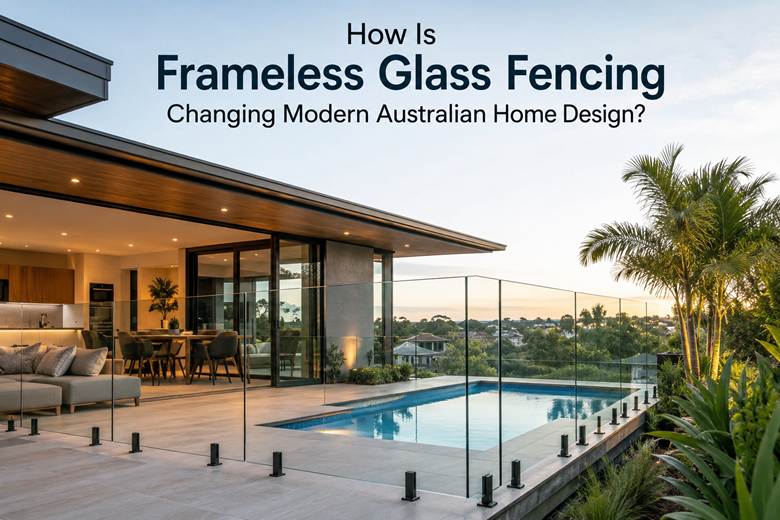
Walk through any recently renovated backyard in Sydney, Melbourne or Brisbane and there’s a good chance you’ll notice it before you notice much else: a fence you can barely see. Frameless glass fencing has become a familiar feature around pools, terraces and courtyards, and its rise says as much about how Australians want to live outdoors as it does about the material itself.
Fencing used to be a purely functional decision, something you installed to mark a boundary or meet a safety requirement, then tried not to think about it again. That’s shifted. Fencing is now treated as part of the overall design of a home, something that can either support or undercut the open, connected feel so many renovations are chasing. Frameless glass sits at the centre of that shift, and it’s worth understanding why, along with where it genuinely makes sense and where it doesn’t.
Why Frameless Glass Fencing Has Become Popular in Australian Homes
It fits the way contemporary Australian homes are being designed. Open-plan living, bifold and stacking doors, alfresco zones that blur into the garden, these design choices are all about reducing the sense of separation between inside and outside. A chunky, framed fence around the pool or garden can quietly work against that effort, reintroducing a visual barrier exactly where the rest of the house has removed one.
Glass doesn’t have that problem. Because it’s transparent and, in frameless installations, free of visible posts and top rails, it can mark a boundary for safety, for definition, for a sense of enclosure without cutting the eye off from what’s beyond it. That’s a genuinely useful property for architects and renovators working with the kind of indoor-outdoor layouts that have become standard in modern Australian design.
There’s also a landscaping angle. Australian gardens, particularly in coastal and subtropical regions, tend to be a selling point in their own right. A fence that hides that landscaping undersells the property. One that doesn’t get out of the way.
How Frameless Glass Fencing Changes the Look of a Property
Take the posts, rails and pickets out of a fence and you take out a lot of visual noise. That’s really the core of the effect. A conventional pool fence, even a well-built one, introduces a repeating pattern of vertical lines that the eye has to process. A frameless glass panel, held in place by discreet base-mounted spigots or a channel system, largely removes that pattern.
The practical result is cleaner sightlines. Standing at the kitchen island or the back door, you see the pool, the lawn, the garden bed, not a fence in front of them. For homes with a deliberately minimalist or contemporary aesthetic, that matters, because a busy fence can look at odds with clean architectural lines elsewhere on the property.
It’s worth being precise about what this does and doesn’t achieve. Frameless glass fencing doesn’t make a pool safer than any other compliant fencing option, and it doesn’t make a garden bigger. What it does is reduce visual clutter, which is a legitimate design outcome even if it’s a modest one.
Making Outdoor Spaces Feel Larger
Does glass fencing make a backyard look bigger?
Not literally the dimensions of the yard don’t change. But transparency can make a space feel less boxed-in, because the eye reads uninterrupted sightlines as openness, and that visual continuity often makes a compact area feel less enclosed than it would behind a solid or heavily framed fence.
This distinction matters more than it sounds. A homeowner comparing a timber paling fence to frameless glass around a small courtyard pool isn’t buying extra square metres, they’re buying a different visual experience of the same square metres. For many inner-city and coastal blocks, where outdoor space is genuinely limited, that perceived openness is one of the more practical benefits glass offers.
Supporting Australia’s Indoor-Outdoor Lifestyle
Australian homes have leaned into indoor-outdoor living for decades, but the way it’s expressed has become more deliberate. Kitchens now open directly onto alfresco dining areas. Living rooms run into decks. Pools sit close enough to the house that they’re visible from the couch, not tucked away at the back of the block.
Frameless glass fencing supports that continuity by not interrupting it. Where a solid fence might visually separate the pool from the garden, or the deck from the lawn, glass keeps those zones reading as one connected space, even though they’re functionally and legally distinct. For entertaining purposes, this can be genuinely practical too; hosts can keep an eye on a pool full of kids from the kitchen without a fence line breaking their view.
A Good Match for Modern Architectural Styles
Frameless glass fencing tends to be associated with high-end architect-designed homes, but that’s more a reflection of where it’s been photographed than where it can be used. In practice, it complements a fairly wide range of residential styles:
- Contemporary and minimalist new builds, where clean lines are already the governing design language
- Coastal properties, where uninterrupted ocean or garden views are often the whole point of the block
- Renovated townhouses and courtyard homes, where compact outdoor areas benefit from reduced visual clutter
- Mid-renovation family homes simply looking to modernise an old pool fence without a major structural overhaul
It isn’t reserved for luxury builds. A standard suburban pool renovation can use frameless glass just as functionally as a bespoke architectural project; the difference tends to be in the surrounding landscaping and finishes, not the fencing itself.
Frameless Glass Pool Fencing: Safety Without Sacrificing the View
Yes, when it’s installed to the applicable safety standards. Frameless glass is a widely used pool fencing option in Australia precisely because it satisfies the same barrier function as any other compliant fence, without blocking sightlines to the water.
That said, appearance should never be treated as a substitute for compliance. Pool fencing in Australia is governed by state and territory regulations, which set requirements around fence height, gap sizes, self-closing and self-latching gates, and the distance climbable objects must be kept from the fence line. These requirements can vary depending on the state or territory you’re in, the layout of the pool, and site-specific factors like fence height above the ground and boundary conditions. This article isn’t a substitute for that guidance, and homeowners should confirm current requirements with their local council or relevant pool safety authority before finalising a design.
Working with an experienced, appropriately licensed installer matters for exactly this reason; someone who regularly installs frameless glass pool fencing will already be familiar with the compliance checks a pool fence needs to pass, not just how to make it look good.
Natural Light, Views and Visual Connection
Because glass doesn’t block light the way a solid or louvred fence does, it can help preserve natural light reaching nearby windows, patios and garden beds though how much difference this makes depends heavily on the fence’s position, the orientation of the home, and how much light was reaching that area to begin with. It’s not accurate to say glass fencing increases light in every property; in some layouts the difference will be negligible.
Where the effect is more consistently noticeable is in preserved views of a garden, a pool, or in coastal properties, the ocean itself. This tends to matter most on smaller urban blocks, where a solid fence has more relative impact on the property simply because there’s less space to absorb it.
Does Frameless Glass Fencing Work With Landscaping?
Generally, yes, and often better than framed alternatives. Because there’s no substantial structure to visually compete with plants, paving or garden beds, landscaping tends to stay the visual focus rather than the fence itself. This applies across a fairly broad range of garden styles native Australian planting, tropical-leaning poolside landscaping, formal modern gardens with structured hedging, or a simple lawn-and-paving setup.
It also pairs reasonably well with common Australian hard landscaping materials: stone paving, timber decking, poured concrete surrounds. Because glass fencing doesn’t need to visually “match” these materials the way a timber or aluminium fence might, it tends to sit comfortably alongside most established landscaping choices rather than dictating a particular palette.
What Homeowners Should Consider Before Choosing Glass Fencing
Frameless glass has real advantages, but it isn’t the right fit for every home or every budget, and a balanced view matters here.
Maintenance
It requires more regular cleaning than most alternatives, since watermarks, dust, salt spray near coastal properties, and general fingerprints and residue are more visible on clear glass than on timber or aluminium. It isn’t maintenance-free, and homeowners who aren’t willing to clean panels reasonably regularly should factor that into the decision.
Cost
Frameless glass fencing generally involves a higher upfront cost than many conventional fencing materials, though the exact figure depends heavily on the glass thickness and grade, the hardware system used, site access, and how much preparation the site needs. Specific pricing varies by installer and project, so it’s worth getting a proper quote rather than relying on rough figures found online.
Installation
Precision matters more with frameless glass than with most fencing types. Panels need to be accurately measured, correctly spaced, and properly secured using appropriate spigots or channel hardware, with attention paid to alignment so panels sit flush and gaps stay within compliant limits. This isn’t a straightforward DIY job for most homeowners; it benefits from experienced installation.
Site Conditions
Sloping ground, existing paving, irregular pool shapes, drainage points, limited access and nearby retaining walls can all affect how a glass fence is designed and installed. A site assessment before finalising a design tends to avoid costly changes later.
Compliance
Pool fencing, in particular, must meet applicable state or territory requirements regardless of the material chosen. This should be checked and confirmed before installation begins, not treated as an afterthought.
How Frameless Glass Fencing Fits Into the Future of Australian Home Design
It would be an overstatement to call frameless glass fencing a dominant trend reshaping the industry; it’s better understood as one component of a broader shift toward flexible, connected outdoor living. Homeowners increasingly want entertaining areas that don’t feel walled off from the rest of the garden, cleaner architectural lines that carry through from the house to the yard, and outdoor features that manage to be functional and safety-compliant without looking heavy-handed.
Frameless glass fencing meets that brief reasonably well, which is part of why it keeps showing up in renovations and new builds alike. Whether it remains as prominent in five or ten years will likely depend on how outdoor living trends evolve more broadly, but for now it addresses a design problem visual separation that a lot of Australian homeowners are actively trying to avoid.
Is Frameless Glass Fencing Right for Your Home?
It tends to suit homeowners who prioritise open sightlines, a minimalist or contemporary look, unobstructed pool visibility, and a boundary that doesn’t compete visually with the rest of the property. If those priorities line up with your renovation or build, it’s worth serious consideration.
It may be less suitable for homeowners who are prioritising a lower upfront cost, more privacy from neighbouring properties, less visible maintenance, or a fencing style that suits a more traditional or heritage aesthetic. In those cases, timber, aluminium slat, or semi-frameless glass options might be a better practical fit. There’s no single correct choice here; it depends on what the property and the homeowner actually need.
For homeowners weighing up options, speaking with an established provider of glass fencing Sydney homeowners already use for pool and boundary projects can help clarify which approach suits a specific site and budget.
Conclusion
Frameless glass fencing has become a familiar feature of modern Australian homes because it solves a specific design problem: how to mark a boundary for safety, for structure, for definition without introducing a visual barrier that works against open, connected living. It suits a genuine range of architectural styles and budgets, not just high-end renovations, and its main practical trade-offs are cost and maintenance rather than any shortfall in what it offers visually.
Good fencing design, glass or otherwise, still needs to balance appearance with safety, function, maintenance and long-term practicality and pool fencing specifically needs to meet the relevant compliance requirements regardless of how it looks. For homeowners weighing up whether frameless glass is the right call for their own property, talking through site conditions, budget and design goals with an experienced local installer is generally the most useful next step.
Frequently Asked Questions
1. Is frameless glass fencing suitable for modern Australian homes?
It generally suits homes with a contemporary, minimalist or indoor-outdoor design focus, where open sightlines and reduced visual clutter are priorities. It’s less about the home’s price point and more about whether the surrounding design language values transparency and clean lines.
2. Does frameless glass fencing make a backyard look bigger?
It doesn’t physically increase the size of a yard, but the lack of visible posts and rails often makes a space feel more open, since sightlines stay uninterrupted. This effect tends to be most noticeable in smaller courtyards and compact pool areas.
3. Is frameless glass pool fencing safe?
It can be, provided it’s installed to meet the pool fencing requirements set by the relevant state or territory authority, including fence height, gap sizes and gate hardware. Appearance alone doesn’t determine safety compliance and correct installation, so it’s important to confirm current requirements and use an experienced installer.
4. How much maintenance does frameless glass fencing require?
More than most alternative fencing materials. Glass shows watermarks, dust, fingerprints and salt residue more visibly than timber or aluminium, so it needs reasonably regular cleaning to keep its clear appearance. It isn’t a maintenance-free option.
5. What should I consider before installing frameless glass fencing?
Budget, ongoing maintenance, site conditions such as slope and access, and compliance with pool safety regulations if it’s being used around a pool. Getting a site assessment and a proper quote from an experienced installer will give a clearer picture than general research alone.